

Ultimate Comprehensive Male Hormone Panel (7 Biomarkers). Available Across the UK
Ultimate Comprehensive Male Hormone Panel (7 Biomarkers). Available Across the UK
Couldn't load pickup availability

Biomarkers/Parameters tested with this comprehensive male hormone panel test kit:
- Testosterone
- Oestradiol (Estrogen)
- Luteinizing Hormone (LH)
- Follicle-Stimulating Hormone (FSH)
- Sex Hormone-Binding Globulin (SHBG)
- Free Testosterone
- Free Androgen Index (FAI)
The report will be quantitative, containing actual figures and remarks for results of the above panel of biomarkers. The report will be sent to your email.
Whether you are on testosterone replacement therapy (TRT) or curious about hormone levels, this test is for you.
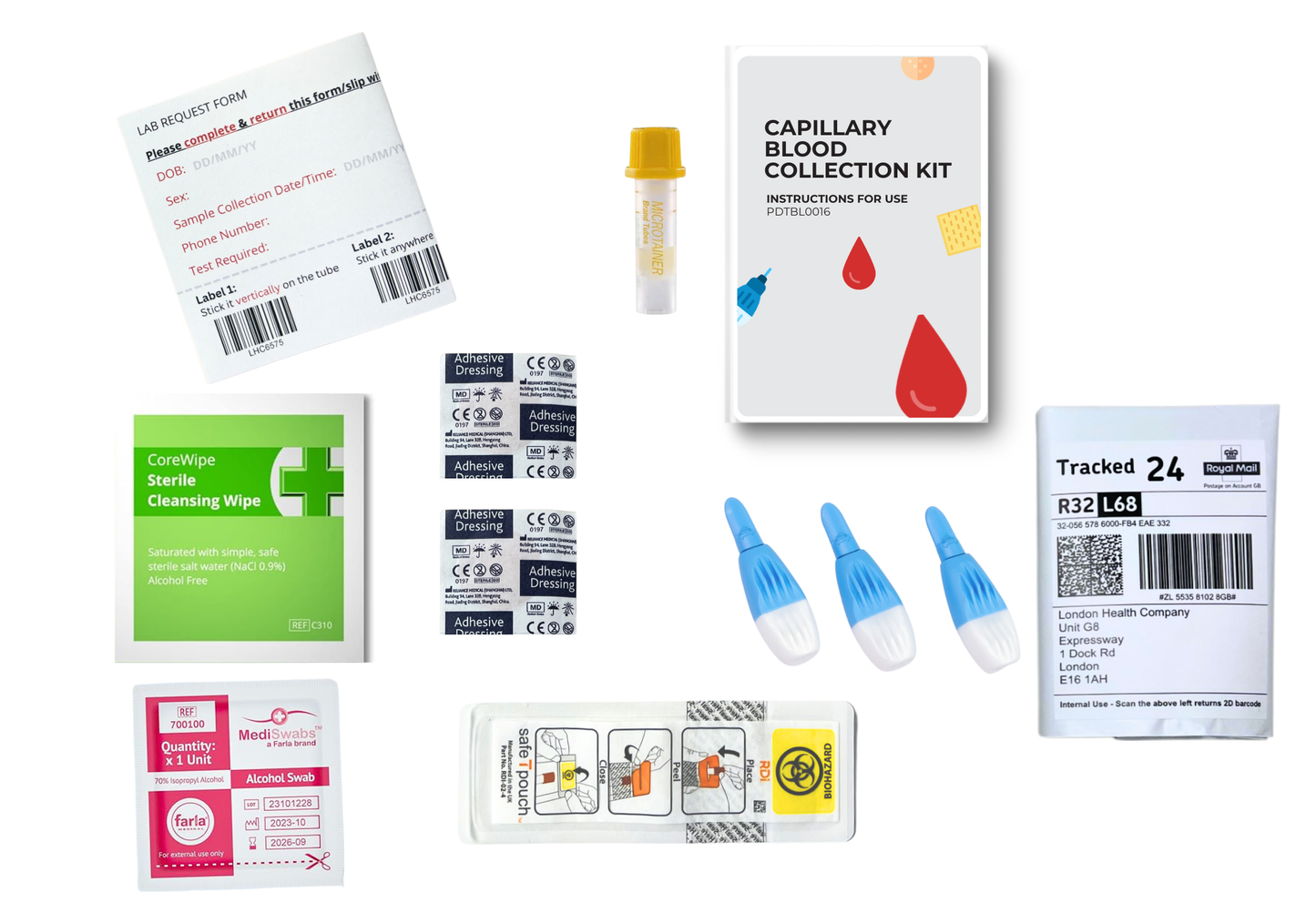
This test provides valuable insights into your hormonal health. You can collect a small blood sample at home using a simple finger-prick kit and send it to our lab for analysis, or you may choose to have your blood drawn at a partner clinic or pharmacy. The kit includes everything you need: lancets, instructions, a lab request form, labels, a blood collection tube, tube pouch, prepaid UN3373 return envelope, tube holder, swabs, alcohol wipes, and plasters.
About the Test
Hormones such as testosterone, FSH, and LH play major roles in the reproductive system, sperm production, sexual functions, and overall well-being.
Male hormones play a crucial role in maintaining a man’s physical, sexual, and mental health. The most well-known hormone is testosterone, which is responsible for the development of male characteristics such as a deeper voice, facial and body hair, increased muscle mass, and sex drive. Other important hormones include follicle-stimulating hormone (FSH) and luteinizing hormone (LH), which regulate sperm production and testosterone release. These hormones work together to ensure proper reproductive function, maintain bone density, support red blood cell production, influence mood and mental focus, and help regulate energy levels. Balanced hormone levels are essential not only for fertility (reproductive system) and sexual health but also for overall physical and emotional well-being.
Fluctuations in male hormone levels, especially testosterone, may cause men to experience reduced sex drive, erectile dysfunction, fatigue, decreased muscle mass, weight gain, mood changes such as irritability or depression, difficulty concentrating, and even reduced bone density. Hormonal imbalances involving FSH and LH can also disrupt sperm production, potentially leading to fertility problems.
Our convenient at-home test is designed to help you pinpoint whether a hormone imbalance could be the underlying cause of your symptoms.
Here's a brief explanation of each of the parameters tested:
1. Testosterone
Testosterone is a primary male hormone mainly produced in the testicles, with smaller amounts also made by the adrenal glands. Testosterone levels in men naturally start to decrease after age 30. However, low levels can happen at any age and may lead to symptoms like reduced sex drive, erectile dysfunction, trouble building or keeping muscle, and low energy.
Its release is regulated by luteinizing hormone (LH), which is secreted by the pituitary gland in the brain. It is also crucial in sperm production and mood regulation. Maintaining optimal levels is key for male health and vitality.
Signs of testosterone deficiency can include:
• Reduced interest in sex (low libido)
• Difficulty getting or keeping erections
• Loss of muscle mass
• Anaemia (low red blood cell count)
• Decreased bone strength (osteopenia or osteoporosis)
• Persistent fatigue and trouble concentrating
• Feeling low or more emotionally sensitive
2. Oestradiol (Estrogen)
In men, estradiol, the main form of estrogen, plays a vital role in sexual health. It is closely connected to male sexual function.
Together with testosterone, estradiol helps regulate:
- Sex drive (libido)
- Healthy erectile function
- Sperm production (spermatogenesis)
When the male body produces too much estradiol, this condition is called hyperestrogenism.
Men with elevated estrogen levels may have a higher risk of developing diabetes or heart problems. Common symptoms of hyperestrogenism include:
- Erectile dysfunction
- Breast tissue growth (gynecomastia)
- Fatigue and low energy
- Excessive sweating or night sweats
- Reduced sex drive
- Infertility
- Mood changes such as anxiety, depression, or mood swings
- Several factors can cause high estradiol levels, including obesity, high stress, poor diet, and aging.
Low estradiol levels in men are usually not a major concern, and many men with low estradiol don’t experience noticeable symptoms. However, since estradiol is partly produced from testosterone, low testosterone levels can result in reduced estradiol. Because of this connection, the symptoms of low estradiol often overlap with those of low testosterone and may include:
- Mood changes such as depression, anxiety, or irritability
- Sexual performance issues
- Low energy and excessive sleepiness
- Increased body fat
- Reduced bone density
3. Luteinizing Hormone (LH)
LH is produced by the pituitary gland and stimulates Leydig cells in the testes.
It triggers testosterone production, making it essential for male reproductive system health.
High or low LH may signal problems with the testes or pituitary gland.
It's commonly tested in cases of low testosterone or infertility.
4. Follicle-Stimulating Hormone (FSH)
FSH (Follicle-Stimulating Hormone) plays a key role in testicular development and supports the production of a protein needed to make healthy sperm. Proper FSH levels are essential for sperm production and overall male fertility.
It works in coordination with LH to regulate reproductive function.
Low levels can indicate pituitary issues; high levels may reflect testicular failure.
It’s a key marker in male fertility evaluations.
5. Sex Hormone-Binding Globulin (SHBG)
Sex hormone-binding globulin (SHBG) is a protein produced by the liver that binds to sex hormones such as testosterone, oestrogen, and DHT, helping regulate their availability and activity in the body. Measuring SHBG levels can provide valuable insights into hormone imbalances. In men, abnormal SHBG levels may be associated with low libido and erectile dysfunction. Maintaining SHBG within a healthy range is important for hormonal balance, reproductive health, and overall well-being.
6. Free Testosterone
Free testosterone is the small amount of testosterone in the bloodstream that is not attached to proteins. Because it’s unbound, this form of testosterone is “active,” meaning it can easily enter cells and carry out its effects, such as supporting muscle growth, sex drive (libido), energy levels, and mood. It plays a major role in how testosterone functions in the body.
It better reflects hormonal activity than total testosterone alone.
Low levels can lead to fatigue, reduced muscle mass, and low libido.
It’s an essential marker in diagnosing male hormone deficiency.
7. Free Androgen Index (FAI)
High androgen levels in men are rare and usually caused by anabolic steroid use, which involves synthetic testosterone to boost muscle mass and athletic performance. Excess androgens can cause symptoms like infertility, erectile dysfunction, shrunken testicles, hair loss, acne, and breast development. On the other hand, low androgen levels, often linked to aging or conditions like type 2 diabetes, can lead to fatigue, depression, reduced muscle mass, and hot flushes, indicating testosterone deficiency or late-onset hypogonadism.
What is the difference between Testosterone and Free Testosterone?